训练

What Is a Spindle Motor?

Mar 03, 2026

A spindle motor drives the spindle of a CNC machine, allowing the cutting tool to rotate at high speed for precise machining. It is the core component that determines cutting performance, surface finish, and production efficiency.

Summary for skimmers:

The main motor that rotates the cutting tool.

Designed for high-speed, continuous operation.


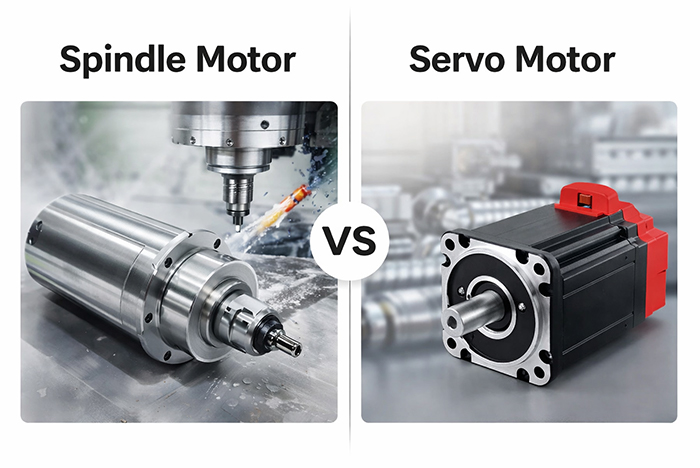
Spindle Motor vs. Servo Motor

Both spindle motors and servo motors are critical in a CNC machine. They often work together — but they are not the same thing.

In simple terms:

The spindle motor rotates the cutting tool.

The servo motor moves the machine axes.

One handles cutting power.

The other controls movement and positioning.


Spindle Motor

A spindle motor is designed to spin the tool at high RPM so material can be cut efficiently.

Key features:

High-speed continuous rotation (8,000–24,000 RPM or more)

Stable torque during cutting

Designed to handle heat and vibration

Focused on power and cutting performance

If the spindle motor is weak, cutting performance drops — even if the rest of the machine is advanced.


Servo Motor

A servo motor controls the movement of the CNC axes (X, Y, Z, and sometimes A/C axes).

Key features:

High positioning accuracy

Fast start-and-stop response

Encoder feedback for precision control

Designed for controlled motion, not continuous high-speed rotation

Servo motors determine how accurately the machine moves, not how it cuts.


Main Types of Spindle Motors

Not all spindle motors are built the same. Different designs serve different machining needs — from heavy steel cutting to high-speed aluminum finishing.

Spindle motors can be classified in several ways, including:

By the drive structure

By the cooling method

By speed range

By application type

Here are the main types you’ll commonly see in CNC machining centers.


Types by Drive Structure

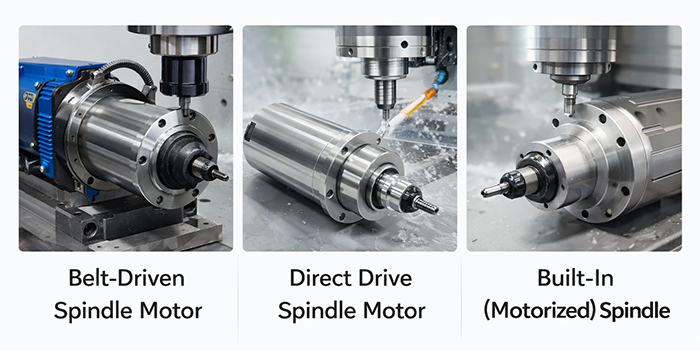
Belt-Driven Spindle Motor

A belt-driven spindle uses an external motor connected by a belt system.

Cost-effective and easy to maintain

Suitable for general machining

Slight vibration at very high speeds

Common in standard vertical machining centers

Best for: General steel cutting and everyday production.


Direct Drive Spindle Motor

A direct drive spindle connects the motor directly to the spindle without a belt.

Higher rigidity

Better speed stability

Lower vibration than belt systems

More precise performance

Best for: Mold machining and higher-precision work.


Built-In (Motorized) Spindle

In this design, the motor is integrated directly inside the spindle unit.

Compact structure

Very high RPM capability

Fast acceleration and deceleration

Excellent for high-speed machining

Best for: Aerospace parts, aluminum machining, and high-speed finishing.


Types by Cooling Method

Spindle motors generate heat during operation. The cooling system affects stability and lifespan.

Air-Cooled Spindle

Simple structure

Lower cost

Suitable for moderate workloads


Oil-Cooled Spindle

Better heat control

More stable during long production runs

Common in high-performance machines


Water-Cooled Spindle

Efficient heat dissipation

Quieter operation

Used in high-speed and precision applications


Types by Speed Range

Spindle motors are also grouped by RPM capability.

Low-Speed, High-Torque (≤6,000 RPM)

Ideal for heavy cutting of steel and large parts.

Medium-Speed (8,000–12,000 RPM)

Balanced performance for general machining.

High-Speed (15,000–24,000 RPM)

Designed for aluminum, mold, and precision finishing.

Ultra-High-Speed (30,000+ RPM)

Used in specialized high-speed machining environments.


Summary for skimmers:

Belt-driven = economical and versatile

Direct drive = more precise and stable

Built-in spindle = high-speed and compact

The cooling system affects stability and lifespan

RPM determines cutting capability


Benefits and Trade-Offs People Care About

When choosing a spindle motor, most buyers focus on performance — but performance always comes with trade-offs.

Understanding both sides helps you avoid overpaying or under-configuring your CNC machine.


Benefits

Higher Machining Efficiency: A powerful spindle motor allows higher cutting speeds and faster material removal rates.

Better Surface Finish: Stable rotation with low vibration improves surface quality, especially in mold and aluminum machining.

Longer Tool Life: Consistent torque reduces tool chatter and uneven wear, helping tools last longer.

Improved Precision: High-performance spindle motors maintain stable RPM under load, supporting tighter tolerances.

Faster Acceleration and Deceleration: Motorized and direct-drive spindles can reach target speed quickly, improving overall machining efficiency.


Trade offs

Higher Initial Cost: Built-in or high-speed spindle motors are more expensive than belt-driven systems.

Maintenance Complexity: Integrated motorized spindles are harder to repair compared to traditional belt systems.

Heat Management Requirements: High-speed operation generates more heat. Advanced cooling systems increase machine complexity.

Repair Cost Can Be High: If bearings or internal components fail, repair costs may be high — especially for built-in designs.

Not Always Necessary: For basic machining tasks, ultra-high-speed spindles may not provide real ROI.


Things to Do Before Buying a Spindle Motor

Buying a spindle motor isn’t just about choosing the highest RPM.

The right choice depends on your material, production goals, and machine setup.

Here are the key things to consider before making a decision.


Understand Your Material

Different materials require different spindle performance.

Steel and cast iron need strong torque at lower speeds.

Aluminum benefits from higher RPM and smooth rotation.

Titanium requires stable power and heat control.

Choosing the wrong speed range can reduce tool life and surface quality.


Check Required Speed and Torque

RPM alone doesn’t define performance.

You must match spindle speed with cutting tool size and cutting strategy.

Ask yourself:

What is your typical cutting depth?

Are you doing heavy roughing or fine finishing?

What spindle power (kW) do you need?

A balanced torque curve matters more than peak speed.


Consider Cooling and Working Hours

If your production runs continuously, cooling becomes critical.

Air cooling works for light workloads.

Oil or water cooling improves stability in long production cycles.

Overheating reduces spindle life and machining accuracy.


Confirm Machine Compatibility

Before purchasing, verify:

Taper type (BT40, BT50, HSK, etc.)

Power supply requirements

ATC compatibility

Machine structure rigidity

Not every spindle motor fits every CNC machine.


Think About Long-Term Maintenance

The purchase price is only part of the cost.

Consider:

Bearing lifespan

Ease of repair

Spare parts availability

Service support

A lower upfront price may lead to higher long-term expenses.


Choosing the Right Spindle Motor for Your CNC Machine

There is no “best” spindle motor — only the one that fits your machining needs.

The right choice depends on your material, machine type, and production goals.

Here’s how to decide.

For General Machining

If you mainly process mild steel, cast iron, or standard mechanical parts:

8,000–12,000 RPM is usually enough

A belt-driven or direct-drive spindle works well

Focus on stable torque rather than extreme speed

Best for: Daily production and balanced performance.


For Heavy Cutting Applications

If your work involves deep cuts or large tools:

Choose a lower RPM with higher torque

Look for strong spindle rigidity

Cooling stability is important

Best for: Automotive parts, structural components, and large molds.


For Aluminum and Mold Processing

If surface finish and speed matter more than heavy cutting:

15,000–24,000 RPM is recommended

Direct-drive or motorized spindle preferred

Fast acceleration improves efficiency

Best for: Aluminum parts, mold finishing, precision components.


For 5-Axis or High-Precision Machining

Complex parts require smooth performance and dynamic response.

Built-in motorized spindle

High precision balance

Advanced cooling system

Best for: Aerospace components and complex geometries.


FAQs

What is the difference between a spindle motor and a regular motor?

A regular motor is designed for general mechanical rotation.

A spindle motor is specifically engineered for high-speed, continuous rotation under cutting load. It must maintain stable torque, minimal vibration, and precise speed control during machining.

In short, spindle motors are built for precision machining — not general power transmission.

How long does a spindle motor last?

Spindle motor lifespan depends on usage and maintenance.

On average:

Standard use: 3–5 years

High-speed continuous production: shorter lifespan

Proper maintenance and cooling: significantly longer life

Bearings are usually the first components to wear.

What causes spindle motor overheating?

Common causes include:

Poor cooling system performance

Excessive cutting load

Worn bearings

Continuous operation at maximum RPM

Improper lubrication

Overheating reduces accuracy and shortens spindle life.

Can a spindle motor be repaired?

Yes, but it depends on the design.

Belt-driven spindles are easier and cheaper to repair.

Built-in motorized spindles are more complex and costly to service.

In some cases, replacing the spindle unit may be more practical than repairing it.

Is higher RPM always better?

Not necessarily.

Higher RPM improves finishing performance, but heavy steel cutting requires more torque than speed.

The best spindle motor balances speed and torque based on your application.

How do I know if my spindle motor is failing?

Warning signs include:

Unusual vibration

Increased noise

Temperature rise

Poor surface finish

Inconsistent RPM

Early detection can prevent major damage.


Conclusion

A spindle motor is the heart of a CNC machine. It determines how well your machine cuts, how smooth the surface finish is, and how stable your production runs.

Different spindle types serve different purposes — high torque for heavy cutting, high RPM for precision and speed. There is no single “best” option, only the one that fits your application.

Choose based on your material, workload, and accuracy needs — and your CNC machine will perform at its best.

留言

留言
如果您对我们的产品感兴趣,想了解更多详情,请在这里留言,我们会尽快回复您。
提交

产品

whatsApp

接触