When people first look into 5-axis CNC machines, they often assume they are all the same.
But once you start comparing models, you quickly notice big differences — in price, structure, size, and performance.
Some machines are designed for small, high-precision mold parts.
Others are built for large aerospace components.
Even though they all claim to be “5-axis,” their real capabilities can vary significantly.
So what makes them different?
The answer lies in machine configuration.
Different types of 5-axis CNC machines affect machining stability, workpiece size capacity, surface finish, and overall production efficiency.
Not all 5-axis machines are structured the same, and understanding these differences is essential before investing.
In this article, we’ll introduce the main types of 5-axis CNC machines and explain how each configuration impacts real-world machining performance.
A 5-axis CNC machine is an advanced machining center that can move a cutting tool or workpiece along five different axes.
It includes:
Three linear axes: X, Y, and Z
Two rotary axes: typically A, B, or C
The additional rotary axes allow the tool to approach the workpiece from multiple angles without repositioning the part.
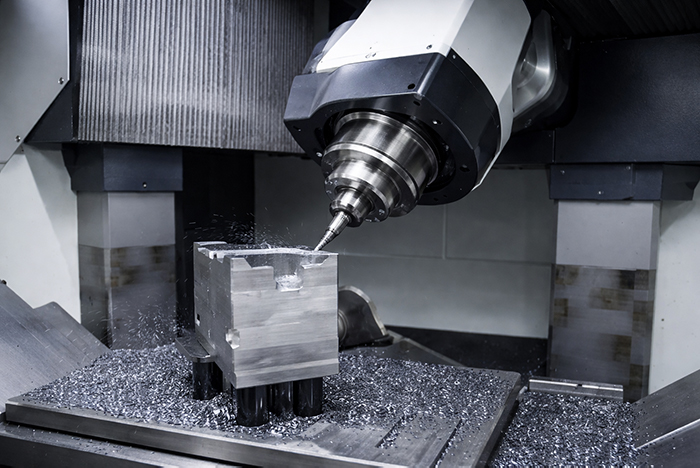
In practical terms, this means the machine can machine complex geometries, deep cavities, and curved surfaces in a single setup.
In a traditional 3-axis machine, the cutting tool only moves up/down, left/right, and forward/backward. To machine multiple sides, the operator must unclamp and reposition the part.
A 5-axis CNC machine eliminates this limitation.
By adding rotational movement, the machine can:
Tilt the worktable
Rotate the spindle head
Or combine both movements
This allows simultaneous machining on multiple surfaces while maintaining a single clamping.
Compared to 3-axis machining, 5-axis systems offer:
Higher machining efficiency
Improved geometric accuracy
Better surface finish on complex parts
Reduced setup time
Lower cumulative positioning error
For industries such as aerospace, mold & die, medical components, and high-precision engineering, 5-axis capability is often essential rather than optional.
Although all 5-axis CNC machines offer multi-directional machining capability, their structural configuration significantly influences performance, part size range, and industry suitability.
Below are the main types of 5-axis CNC machines and how they are typically used in real production environments.

Description
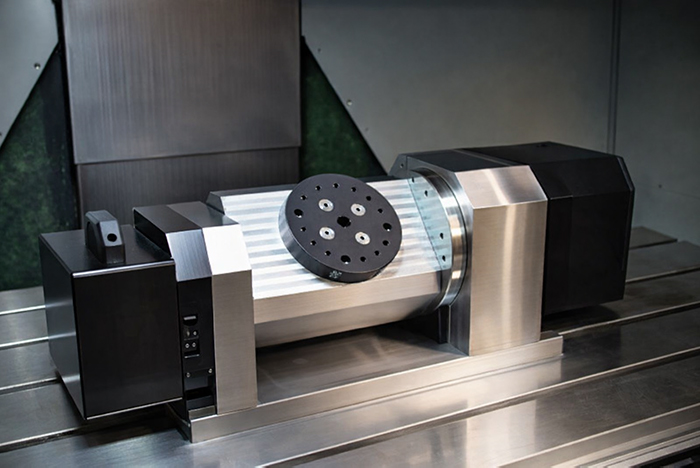
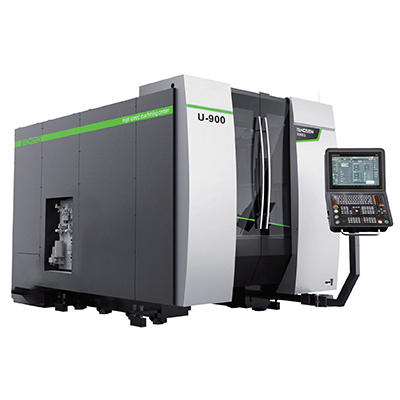
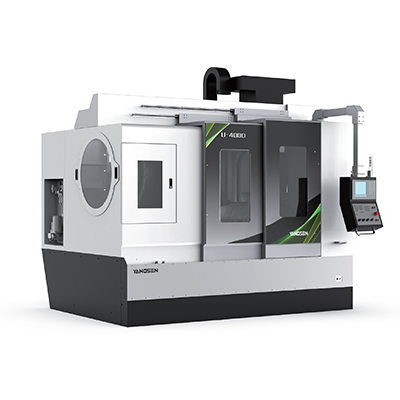
A trunnion-type 5-axis CNC machine integrates both rotary axes into the worktable. The table tilts and rotates, while the spindle remains vertically fixed. This structure creates a compact and rigid machining platform, especially suitable for high-precision contour work.
Typical Industries
This type is widely used in mold and die manufacturing, medical device production, and small aerospace component machining. In mold shops, trunnion machines are valued for their stability during high-speed finishing. In the medical field, they are often used to machine complex implant geometries where accuracy and surface quality are critical. Aerospace suppliers may use them for smaller structural brackets or precision aluminum components.
Suitable Parts
Trunnion machines are ideal for parts such as injection molds, die-casting molds, orthopedic implants, small turbine blades, and complex aluminum housings. These parts typically require multi-surface machining, tight tolerances, and fine surface finishes within a compact work envelope.
Benefits
Excellent structural rigidity
High contour machining accuracy
Compact footprint
Efficient multi-surface machining
Downsides
Limited workpiece size capacity
Restricted table load compared to head-type systems

Description
In a head/head configuration, both rotary axes are integrated into the spindle head rather than the table. The worktable remains fixed while the spindle tilts and rotates to approach the workpiece from multiple angles.
This structure is particularly advantageous when machining large or heavy parts.
Typical Industries
Head-type 5-axis machines are commonly found in aerospace, automotive, structural manufacturing, defense applications, and energy equipment production. Aerospace manufacturers use them for machining structural aluminum frames, titanium components, and complex load-bearing parts. Automotive suppliers rely on them for large molds and structural housings.
Suitable Parts
These machines are well-suited for aircraft structural components, engine housings, transmission cases, large aluminum frames, and complex titanium aerospace brackets. Because the table does not rotate, heavier workpieces can be machined more safely and efficiently.
Benefits
Suitable for large and heavy components
Flexible tool access to complex geometries
No rotating table load limitation
Downsides
More complex mechanical structure
Higher equipment investment
Increased maintenance considerations

Description
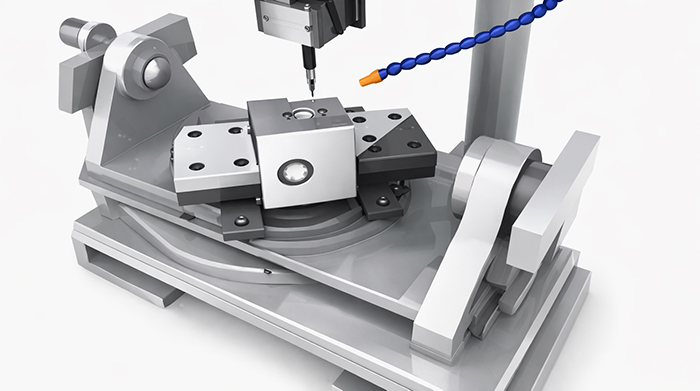
The table/table configuration places both rotary axes within the table system, while the spindle head remains fixed. This design focuses on positioning precision and balanced structural performance.
It offers a stable machining environment for medium-sized precision components.
Typical Industries
This type is commonly used in precision engineering industries, tooling and fixture manufacturing, medical equipment production, and electronics component machining. It is especially valued where repeatability and geometric accuracy are critical over long production runs.
Suitable Parts
Typical applications include precision housings, tooling fixtures, high-accuracy brackets, complex mechanical components, and medium-sized structural parts requiring multi-angle machining. These parts often demand consistent dimensional accuracy and stable contour control.
Benefits
High positioning precision
Stable and balanced structure
Reliable repeatability
Downsides
Medium workpiece size limitation
The rotary system requires precise calibration

Description
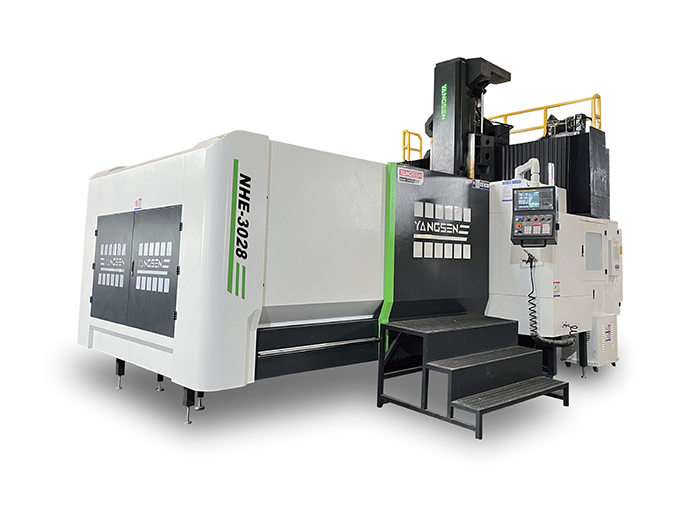
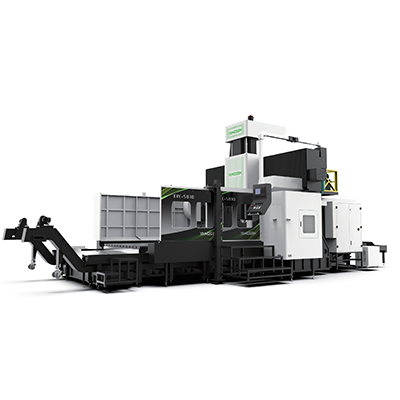
A gantry 5-axis CNC machine features a bridge-type frame structure designed for large-scale machining. It often combines a gantry system with a swivel head configuration, enabling machining of oversized workpieces.
This type emphasizes rigidity and heavy-duty performance.
Typical Industries
Gantry 5-axis machines are widely used in aerospace manufacturing, wind power equipment production, shipbuilding, rail transportation, and heavy machinery industries. They are particularly suitable for sectors that require machining of large structural components with high dimensional stability.
Suitable Parts
Typical parts include aircraft wing structures, wind turbine hubs, large molds, ship components, heavy steel frames, and large composite tooling structures. These components usually exceed the capacity of standard machining centers and require a stable, large-format platform.
Benefits
Extremely high rigidity
Suitable for ultra-large components
Strong heavy-duty machining capability
Downsides
Large installation footprint
Higher infrastructure requirements
Significant investment cost
What are the main types of 5-axis CNC machines?
The main types include trunnion-type, head/head (swivel head) type, table/table type, and gantry 5-axis machines. The difference lies in where the two rotary axes are located—either in the table, the spindle head, or a gantry structure. This structural variation affects rigidity, workpiece size capacity, and overall machining flexibility.
Which type of 5-axis CNC machine is best for mold making?
Trunnion-type machines are commonly preferred for mold manufacturing because they provide high rigidity and excellent contour control within a compact workspace. For very large molds, however, a gantry 5-axis machine may be more suitable due to its extended travel and structural stability.
Are head-type 5-axis machines better for large aerospace parts?
Yes, head/head configurations are often used in aerospace because the worktable remains fixed, allowing heavier and larger parts to be machined without rotational load limitations. This structure is especially useful for aircraft frames, engine components, and structural aluminum or titanium parts.
What is the difference between simultaneous 5-axis and 3+2 machining?
Simultaneous 5-axis machining allows all five axes to move at the same time, enabling smooth contour machining and superior surface finishes. In contrast, 3+2 machining (also called indexed machining) locks the rotary axes in position while cutting with three axes. Simultaneous machining is better for complex surfaces, while 3+2 is often sufficient for multi-face machining at a lower cost.
How much does a 5-axis CNC machine cost?
The price varies significantly depending on machine type, travel size, control system, and structural rigidity. Compact trunnion models generally require lower investment compared to large gantry or head-type aerospace machines. In addition to the purchase price, buyers should consider installation space, tooling systems, and long-term maintenance costs.
How do I choose the right 5-axis configuration for my production?
The selection depends on several factors, including part size, material type, required accuracy, and production volume. Small precision components typically benefit from trunnion designs, while large structural parts may require head-type or gantry systems. Matching machine structure to application requirements is more important than simply comparing specifications.
Although all 5-axis CNC machines share the same basic concept, their structural configurations create very different machining characteristics.
The location of the rotary axes — whether in the table, the spindle head, or within a gantry system — directly influences rigidity, workpiece size capacity, machining flexibility, and long-term stability.
Trunnion designs are often preferred for compact, high-precision components.
Head-type systems are better suited for large and heavy structural parts.
Table/table configurations focus on positioning accuracy and balance.
Gantry machines support ultra-large and heavy-duty applications.
There is no single “best” 5-axis CNC machine.
Each type is designed to serve a specific production environment and machining objective.
Understanding these structural differences makes machine selection clearer and more strategic, especially for manufacturers planning long-term investment and production growth.
Taking time to evaluate configuration, part size, and application requirements will always lead to more confident decisions.